

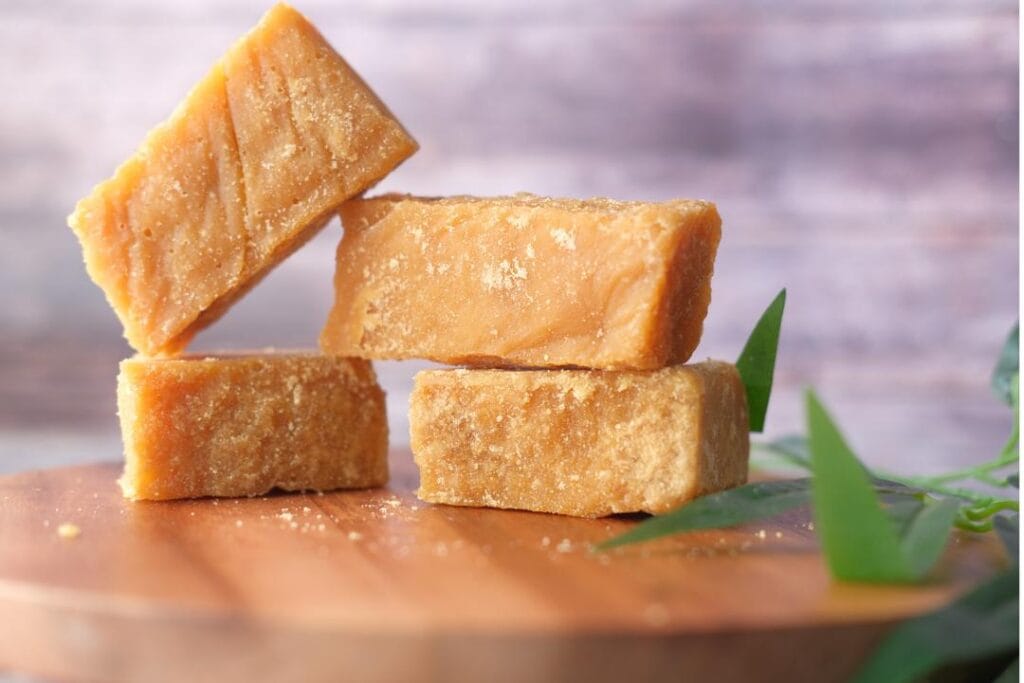
Nowadays, people are searching for the best replacement for refined sugar; consequently, jaggery has emerged as a popular alternative. To conclude, you’ll have to know the nutritional facts of jaggery and its health benefits. First, let us know what jaggery is.
Understanding Jaggery: A Natural Sweetener
Jaggery is an unrefined sweetener, famous throughout Asia and Africa. Jaggery has a rich history and has been used for over a thousand years. Furthermore, it remains a leading ingredient in Indian cuisine.
People have used jaggery in Ayurvedic medicine and remedies for many years. Additionally, it serves as a sweetener in traditional Indian recipes. Jaggery is known by different names. But in India, it is known as Gur.
To make jaggery, people first extract the juices from palms or sugarcane and clarify them to get a clear liquid. Then, this liquid is boiled in a large pan to make it concentrated.
It is concentrated until it solidifies and forms a semi-solid mass in light golden or dark brownish colour. Colour and texture are necessary to determine the quality of jaggery.
Indians prefer light-coloured to dark-coloured jaggery. It is considered a good quality jaggery containing more than 70% sucrose.
Nutritional Facts of Jaggery: What’s Inside it?
Now, let us understand more about the nutritional facts of jaggery and how it is beneficial for your health.
Jaggery is very popular as a replacement for refined sugar because it contains more vitamins and minerals, making it comparatively healthier than other sugars. However, consuming more of this is also not good for your health.
Notably, jaggery contains more nutrients than other sugars as it has a higher molasses content.
Molasses is a nutritional by-product that is often removed when making refined sugar.
Let’s take a closer look at its nutrient profile.
According to studies, a 100g serving of jaggery contains:
| Calories | 383 |
| Sucrose | 65-85 grams |
| Fructose and glucose | 10-15 grams |
| Protein | 280 mg |
| Potassium | 1056 mg |
| Calcium | 40-100 mg |
| Magnesium | 70-90 mg |
| Manganese | 0.2-0.5 mg |
| Phosphorous | 20-90 mg |
| Iron | 11 mg |
| Vitamin A | 3.8 mg |
| Vitamin C | 7.0 mg |
| Vitamin E | 111.30 mg |
The following is for 100g serving, but an individual would only consume a much lesser amount of sugar daily.
Moreover, jaggery takes more time to digest, thus, it does not release energy as quickly as refined sugar, making it easier for the body.
The Health Perks of Jaggery
Nowadays, people are more conscious about health and fitness. Sugar has been replaced by jaggery as it has several health benefits that you can include in your balanced diet.
Several health benefits of jaggery are as follows:
Helps with Weight Loss
People have been facing obesity and the main reason for this is sugar. Consuming sugar can lead to weight gain since they are high in calories. Jaggery takes longer to digest than sugar, making you feel fuller instead of increased hunger.
Jaggery helps in weight loss if consumed moderately. The potassium richness will balance electrolytes, reduce water retention, and increase metabolism. So it burns your calories efficiently.
Prevents Anemia
The occurrence of anemia has increased in India among children and adults, mainly among adolescent women. To prevent anemia, it is necessary to maintain RBCs along with iron.
Jaggery is an iron-rich sweetener that will help you prevent anemia. Including other iron-rich foods like nuts, leafy greens, and legumes will support overall iron levels.
Detoxification of Liver
Jaggery’s natural sugar and minerals cleanse the liver by flushing out toxins from your body. It also enhances liver function and overall digestive health.
However, make sure to have a talk with your healthcare professional before incorporating jaggery into your diet and lifestyle.
Purification of Body
When it comes to body purification, jaggery’s natural properties, such as antioxidants and minerals, can help.
Detoxifier:
Antioxidants and minerals in jaggery will remove the toxins from your body.
Digestive Cleanser:
It stimulates digestion and eliminates waste.
Blood Purifier:
Iron and antioxidants present in jaggery cleanse blood.
There are more benefits when you include jaggery in your diet, namely;
- Relieve constipation and indigestion
- Increase energy levels
- Relieve stress
- Treat lung and bronchial infections.
- Promotes healthy skin
- Boosts immune system
- Relieve menstrual pain
Jaggery Vs Refined Sugar: The Better Choice
When you compare jaggery with refined white sugar, jaggery is a better choice as it is slightly more nutritious than sugar.
Sugar undergoes many more processes, during which it loses its natural nutrition while jaggery undergoes no vigorous treatment. Therefore, jaggery has more minerals, iron, and fiber and takes longer to digest. While sugar takes less time, making you crave more sugary foods.
Moderation is the Key.
Whether it is jaggery or sugar, enjoying either in moderation is necessary. Excessive consumption of both can negatively affect your health.
Jaggery Vs Honey: A face-off
Both jaggery and honey have unique benefits, making them excellent natural sweeteners. Well, jaggery has more minerals than honey.
Honey has antibacterial and antifungal properties that help aid wounds, sore throats, and many more.
Jaggery supports digestion, reduces anemia, helps in weight management, and is a natural energy booster.
Including both in your diet will help you improve your overall physique, as both are rich in vitamins and minerals. You can decide according to your taste preference.
Overconsumption Warning: Jaggery’s Dark Side
Even though jaggery is more nutritious than sugar, jaggery is still a type of sugar. Everything has its limits, and so does intake of jaggery.
Now, are you curious to know about the health risks of overconsumption of jaggery? Let’s point some of it down.
- Obesity
- Heart diseases
- Diabetes
- Liver diseases
- Allergies
By being aware of these potential risks, you can take precautions and enjoy jaggery’s benefits with a balanced diet.
Sweet Treats: DIY’s Using Jaggery
You can explore the nutritional facts of jaggery by incorporating it into various recipes for food, skincare, health, and wellness.
- Many traditional Indian sweets include jaggery to make them tastier and healthier. You can use jaggery to make papdi, cookies, cake, syrup, and payasam.
- Jaggery with lemon juice and honey is an excellent detox drink.
- Jaggery with herbal teas( turmeric, ginger, triphala) is a soothing drink and a natural digestive aid.
- Jaggery and turmeric are suitable for treating throat pain.
- Jaggery and cinnamon are used to balance blood sugar.
- You can use jaggery and milk for a good night’s sleep.
- Jaggery with honey and yogurt is a nourishing face mask.
Incorporating Jaggery into Your Lifestyle
Unrefined and unprocessed sugar, jaggery is a nutrient-rich superfood packed with essential vitamins and minerals. Its minimal processing makes it a healthier choice.
Jaggery contains vitamins and minerals like calcium, phosphorus, potassium, iron, magnesium, carbohydrates, protein, and fiber and does not contain fat. These minerals help boost your immunity, improve skin health, regulate blood sugar, and aid digestion.
It also contains many other remedies that will control blood pressure, detoxify the liver, fight anemia, relieve constipation, and relieve joint pain and menstrual cramps.
Jaggery is an excellent energy source, and consuming 10-12 grams daily is healthier.
Jaggery is a type of sugar, but replacing refined sugar with jaggery is a better choice.